
Electric, Hybrid, and Gas Vehicles: Weighing the Tradeoffs for Everyday Families
Upfront cost, fuel savings, charging logistics, and range all differ across powertrains. Here is a balanced look at each option for typical family use.
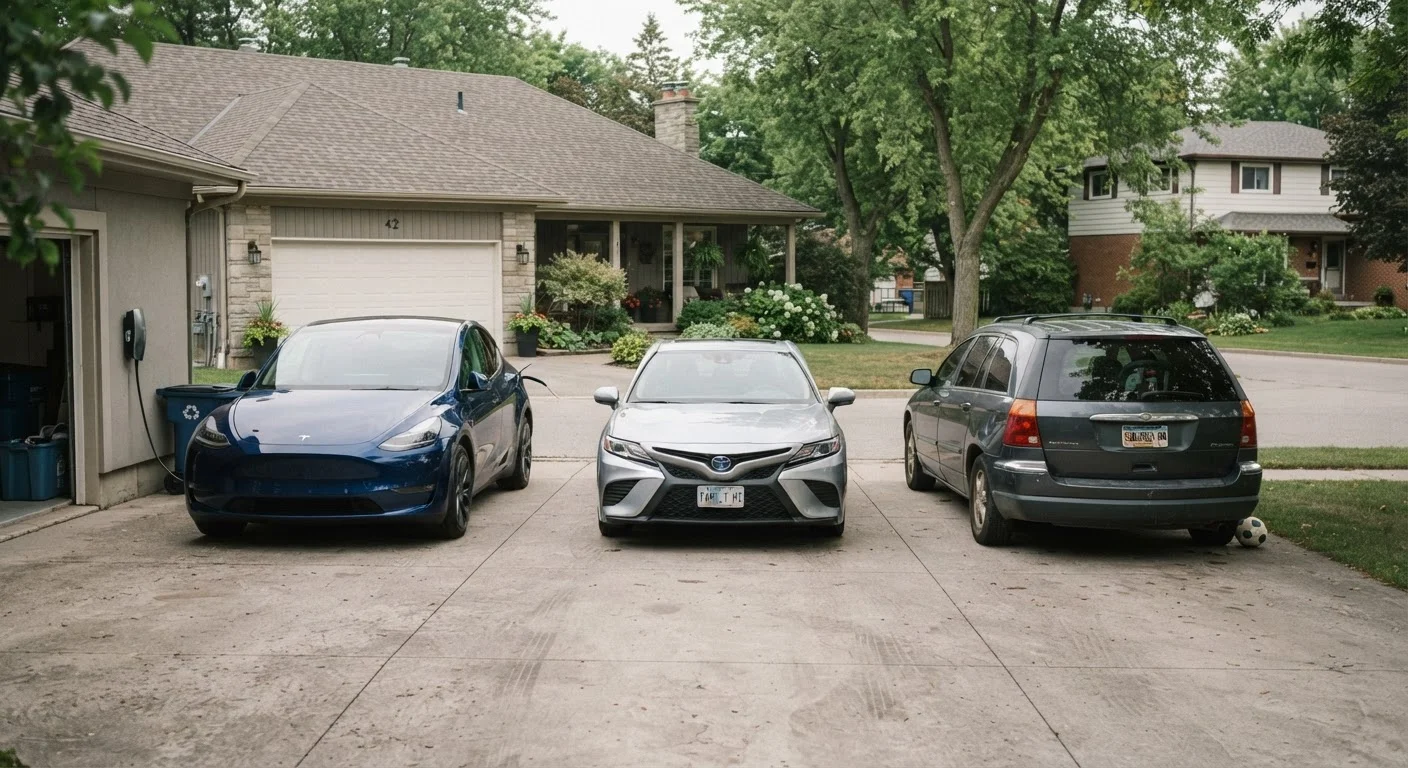
Photo: clearvisionmethod.net editorial
—— In This Article
Key Takeaways
- Electric vehicles have higher sticker prices but lower per-mile fuel and maintenance costs over time.
- Hybrids require no behavior change around charging and often offer the steadiest total ownership costs.
- Gas vehicles remain the most accessible upfront but carry the highest long-term fuel exposure.
- Home charging availability is a practical constraint that can shift the math significantly for EVs.
- Depreciation patterns differ by powertrain and can affect the real cost of ownership substantially.
What you are actually comparing
Choosing between an electric, hybrid, or gas vehicle is not just a technology preference. It is a financial decision that plays out over several years of fuel bills, maintenance visits, and eventual resale. Each powertrain has real advantages, and each has costs that are easy to underestimate at the dealership.
For context: a battery electric vehicle (EV) runs entirely on electricity stored in an onboard battery pack. A hybrid uses a gasoline engine paired with an electric motor, with the battery recharged through braking and the engine rather than a plug. A plug-in hybrid (PHEV) adds a larger battery that can be charged externally, allowing short all-electric trips before the gas engine takes over. A conventional gas vehicle uses only an internal combustion engine. This article covers all four in the comparisons below, grouping PHEVs with hybrids where the distinction matters.
For a deeper look at how fuel efficiency figures are calculated across these types, see this breakdown of MPG and MPGe ratings.
Upfront cost and available incentives
Electric vehicles generally cost more at purchase than comparable gas models, though the gap has narrowed. The federal clean vehicle tax credit (up to $7,500 for qualifying new EVs, subject to income and vehicle price caps under current IRS rules) can reduce the out-of-pocket cost meaningfully, but it is not a guaranteed discount for every buyer or every vehicle. Some states add their own credits; others do not.
Hybrids typically sit between gas and electric on sticker price. Standard hybrids rarely qualify for federal credits, but PHEVs may qualify for a partial credit depending on battery capacity.
Gas vehicles still carry the lowest average transaction prices across most vehicle classes. For families working within a strict monthly payment ceiling, that starting point matters, since a lower purchase price also means a smaller loan balance and less interest paid over time.
| Electric (BEV) | Plug-in Hybrid (PHEV) | Standard Hybrid | Gas Only | |
|---|---|---|---|---|
| Typical upfront cost | Highest | High | Moderate | Lowest |
| Federal tax credit eligibility | Up to $7,500 (if qualified) | Partial credit possible | Generally not eligible | Not eligible |
| Per-mile fuel cost | Lowest (home charging) | Very low (short trips) | Low | Highest |
| Routine maintenance cost | Low | Moderate | Moderate | Higher |
| Charging or refuel time | 30 min to hours | 30 min to hours | Minutes (gas only) | Minutes |
| Home charging required | Strongly recommended | Helpful but optional | Not needed | Not needed |
| Long-trip flexibility | Requires planning | Good (gas backup) | Excellent | Excellent |
| Depreciation predictability | Less predictable | Moderate | Stable | Most established |
Before signing anything, verify current incentive eligibility through the IRS or your state's energy office. Rules change, and not every vehicle or buyer qualifies. The buying versus leasing breakdown also covers how incentives interact differently with lease versus purchase arrangements.
Fuel and energy costs over time
This is where EVs tend to recover their price premium, provided the family drives enough miles. Electricity generally costs less per mile than gasoline, though the exact figure depends on local utility rates and whether home charging (the most affordable option) is available. Families without a garage or dedicated parking may rely on public charging networks, where per-kWh prices are higher and sometimes comparable to gas costs.
Standard hybrids cut fuel spending relative to a gas vehicle without requiring any charging infrastructure. A hybrid rated at 40-plus MPG versus a gas vehicle at 28 MPG produces a real annual savings for most driving patterns. PHEVs can come close to EV-level fuel costs for families whose daily trips fall within the all-electric range, but longer trips shift that calculation.
Gas vehicles expose owners most directly to fuel price volatility. When pump prices spike, the cost shows up immediately in household budgets with no buffer.
Calculate your actual break-even point
Take the price difference between an EV or hybrid and an equivalent gas vehicle, then divide it by your estimated annual fuel savings. That gives a rough break-even timeline in years. If you plan to keep the vehicle past that point, the more efficient option is likely to save money overall. If you typically trade every three or four years, the math may not favor the higher upfront cost.
Maintenance and long-term ownership costs
EVs have fewer moving parts than gas vehicles. No oil changes, no transmission fluid, fewer brake replacements (regenerative braking reduces wear). This does reduce routine maintenance costs over time. The potential downside is battery replacement, which remains expensive, though battery longevity has improved and most manufacturers cover battery capacity under warranty for 8 years or 100,000 miles.
Standard hybrids combine moderate complexity with reasonable reliability records. They require oil changes and brake service, but regenerative braking still extends brake life compared to conventional cars. Long-term reliability data on hybrids is more established than for EVs simply because the technology has been in wide use longer.
Gas vehicles have the most established and widely available repair network. Any independent shop can service them, parts are broadly available, and there are no concerns about battery degradation. The tradeoff is more frequent consumable costs: oil, filters, spark plugs, belts.
Vehicle depreciation also varies by powertrain. EV resale values have been less predictable in recent years due to rapid model updates and changing incentive structures, which is worth weighing if the family plans to sell within five years.
Charging logistics and range
Range anxiety is real for some families and irrelevant for others. A family that drives 30 miles a day and charges overnight at home will rarely think about range. A family that regularly makes 300-mile trips or lives in an area with sparse public charging infrastructure will feel the constraint more acutely.
Home charging requires either a standard 120V outlet (slow, adds roughly 3 to 5 miles of range per hour) or a 240V Level 2 charger installed by a licensed electrician (faster, adds roughly 20 to 30 miles per hour). Renters and apartment dwellers may have no reliable access to either. That is a genuine barrier, not a minor inconvenience.
Hybrids and gas vehicles refuel in minutes at any of the roughly 150,000 gas stations across the country. That flexibility has real value for families with unpredictable schedules or long drives.

Autos Editorial Team
Autos Editorial Team is the collective byline for our editorial team and contributor network. Articles published under this byline or an editorial pen name are researched, written, and reviewed according to our editorial standards for clarity, consistency, and independence before publication.
View author profile