
How Vehicle Depreciation Works and Why It Matters for Family Budgets
Cars lose value the moment they leave the lot. Understanding depreciation curves can help families make smarter buying and selling decisions.
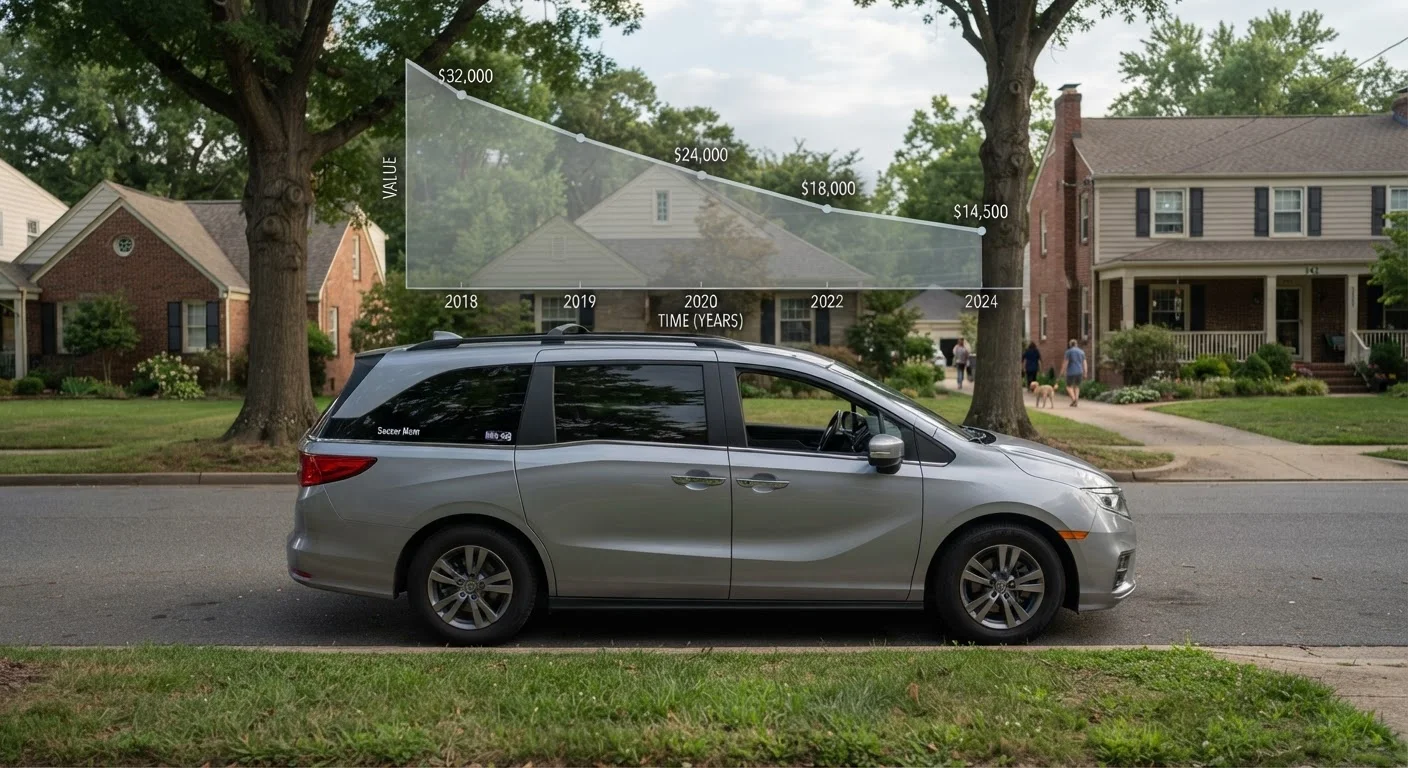
Photo: clearvisionmethod.net editorial
—— In This Article
Key Takeaways
- New vehicles typically lose 15 to 25 percent of their value in the first year alone.
- The steepest depreciation occurs in years one through three of ownership.
- Buying a vehicle that is two to four years old transfers much of that early loss to the original owner.
- Depreciation affects both buying and selling decisions, and it interacts directly with loan balances.
- Vehicle type, mileage, condition, and broader market demand all influence how fast a specific model loses value.
Why depreciation is a real cost, even when you don't see it
Most vehicle costs show up as direct payments: loan installments, insurance premiums, fuel, repairs. Depreciation is different. It drains money silently because it represents value you paid for but will not recover when you sell or trade in.
If a family buys a new vehicle for $40,000 and sells it five years later for $20,000, $20,000 in value is gone regardless of how well the vehicle was maintained. Spread across five years, that is $4,000 per year in depreciation cost alone, before a single loan payment or oil change.
Understanding this cost matters because it is often the largest single line item in total vehicle ownership, frequently exceeding fuel or maintenance over a five-year period. Families who factor depreciation into their vehicle decisions make fundamentally different choices than those who only look at monthly payments.
How the depreciation curve works
Depreciation is not linear. The curve is steepest in the early years and flattens as a vehicle ages.
A typical pattern looks roughly like this:
- Year 1: 15 to 25 percent of original value lost
- Years 2 and 3: an additional 10 to 15 percent per year
- Years 4 and 5: roughly 8 to 12 percent per year
- After year 5: the rate of loss slows further
These are general ranges. Specific models, market demand, fuel economy ratings, and broader economic conditions all shift where a vehicle falls within those ranges. A model with strong consumer demand and a proven reliability record will hold value better than one with weak demand or a history of costly repairs.
20%
Typical first-year value loss for a new vehicle
Industry valuation guides such as Kelley Blue Book and Edmunds consistently show most new vehicles lose roughly 20 percent of their value within the first 12 months of ownership.
~50%
Value remaining after five years of average ownership
Across most vehicle categories, a vehicle retains roughly half its original purchase price after five years, though models with strong demand and reliability records can do notably better.
$4,000+
Average annual depreciation cost on a $40,000 vehicle
A vehicle purchased for $40,000 and sold for $20,000 five years later represents $4,000 per year in depreciation cost, independent of any loan payments or operating expenses.
The practical implication: a family that buys a vehicle new and keeps it for ten years absorbs the entire depreciation curve. A family that buys a two- or three-year-old vehicle lets the original owner absorb the steepest drop, then rides a flatter curve from that point forward.
Depreciation and the risk of negative equity
Depreciation interacts directly with auto loan balances. In the early months of a loan, most of each payment goes toward interest rather than principal. At the same time, the vehicle is losing value fastest. This combination can leave a family owing more than the vehicle is worth, a condition known as negative equity or being upside down.
For example, a buyer who puts little or nothing down, finances over 72 or 84 months, and drives a vehicle with above-average depreciation may find themselves underwater for two years or more. If the vehicle is totaled or must be sold during that period, the family owes the lender the loan balance but receives only the depreciated market value in return. The gap becomes an out-of-pocket expense.
Gap insurance (Guaranteed Asset Protection) is a product designed to cover that difference in a total-loss event. Whether it makes financial sense depends on the loan structure, down payment, and how quickly a specific model depreciates. This is general information; families should review their own loan terms and consult their insurance provider for guidance specific to their situation.
For a closer look at how loan structure affects total cost, see how loan terms and interest rates shape your payment.
What this means when you're buying
Families who understand depreciation tend to think about vehicle purchases differently. The question shifts from "what can I afford per month" to "how much value will this vehicle retain over the time I plan to own it."
A few factors worth weighing:
- Age at purchase. Buying a vehicle that is two to four years old transfers much of the early depreciation loss to the original owner. The vehicle still has useful life remaining, but the price already reflects the steepest value drop.
- Planned ownership length. The longer a family keeps a vehicle, the smaller the annual depreciation cost becomes, because the total loss is spread over more years. Short ownership cycles with new vehicles carry the highest depreciation cost per year.
- Vehicle category. Some categories historically retain value better than others, though this varies by model and market conditions. Fuel economy, reliability reputation, and consumer demand all feed into resale value.
- Mileage and condition. These directly affect resale value and therefore the effective depreciation rate during ownership.
Several widely repeated beliefs about used vehicles can lead families to overlook genuinely sound options. Worth reading before ruling out the used market.
Families also weighing whether to lease rather than buy should consider that lease payments are partly structured around the vehicle's expected depreciation during the lease term. See a practical breakdown of buying versus leasing for how each path handles this cost differently.
Frequently Asked Questions

Autos Editorial Team
Autos Editorial Team is the collective byline for our editorial team and contributor network. Articles published under this byline or an editorial pen name are researched, written, and reviewed according to our editorial standards for clarity, consistency, and independence before publication.
View author profile