
Buying vs. Leasing a Family Vehicle: A Practical Breakdown
Leasing offers lower monthly payments while buying builds equity. See how each path plays out for families with different driving habits and budgets.
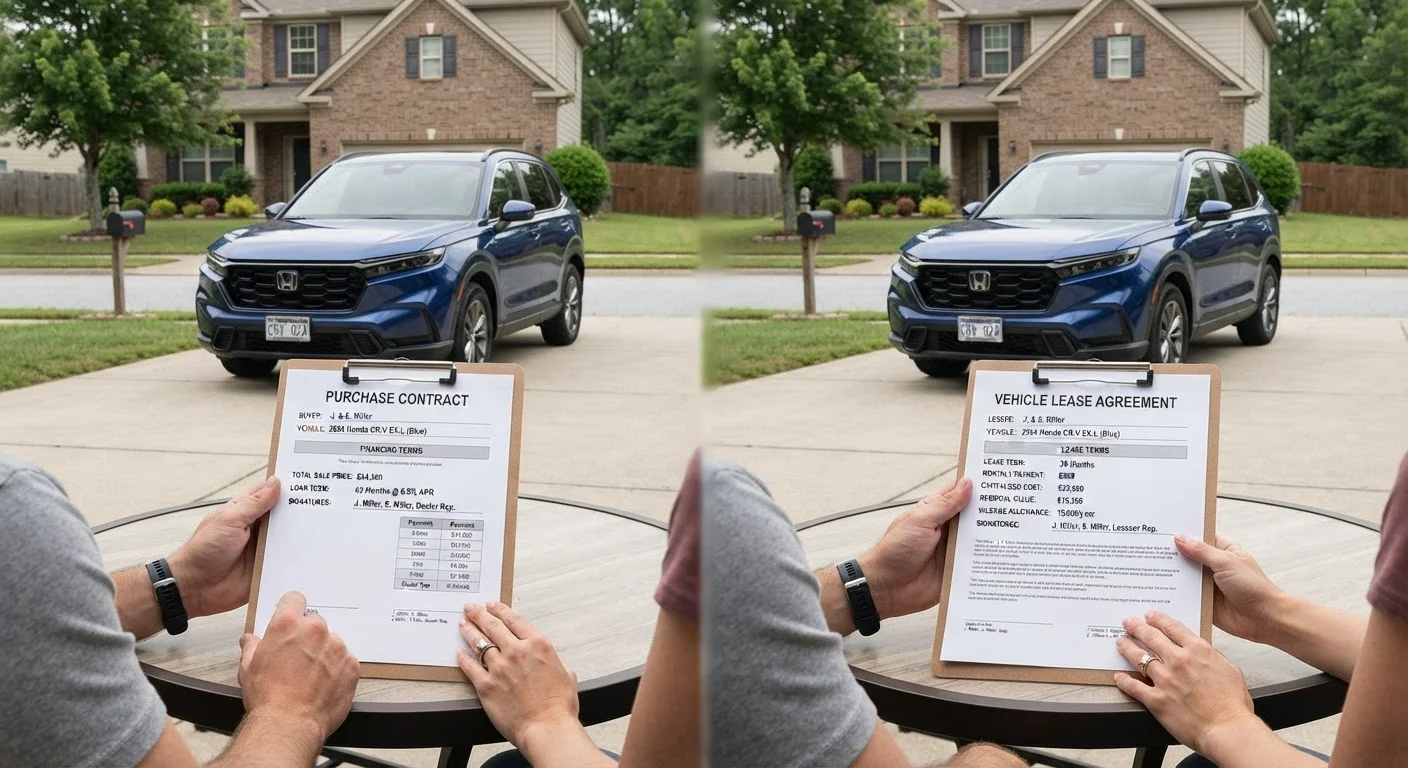
Photo: clearvisionmethod.net editorial
—— In This Article
Key Takeaways
- Leasing typically produces lower monthly payments but no ownership equity at term end.
- Buying costs more each month but builds an asset that can be sold or kept payment-free.
- Mileage limits and wear fees make leasing expensive for families who drive heavily.
- Total cost of ownership over five-plus years generally favors buying for high-mileage drivers.
- Credit score and available cash both affect which option is financially accessible.
What you actually pay: the monthly payment picture
Lease payments are calculated on the portion of a vehicle's value you consume during the lease term, not the full price. A vehicle priced at $40,000 with a residual value of $24,000 after three years means you finance roughly $16,000 worth of depreciation, plus fees and interest (called the money factor in lease contracts). That math typically produces a payment $100 to $200 lower per month than a comparable purchase loan at current rates.
A purchase loan finances the entire vehicle price minus your down payment. Monthly payments are higher, but each one reduces what you owe on an asset you own. Once the loan is paid off, that payment disappears. A leased vehicle restarts the payment cycle at the end of every term. For families who run the numbers over ten years, the no-payment period after a purchase loan clears is often where buying wins financially. See how loan terms and interest rates shape your monthly payment for a closer look at the purchase side of that equation.
Mileage, wear, and the hidden costs of leasing
Lease contracts specify an annual mileage allowance, most commonly 10,000 or 12,000 miles. Overages typically run $0.15 to $0.25 per mile at lease end. A family that drives 18,000 miles per year on a 12,000-mile lease faces a bill of $900 to $1,500 for that year alone, on top of all monthly payments already made.
Excess wear charges are a second cost families often underestimate. A lease agreement defines acceptable wear, and anything beyond that standard (door dings, interior stains, tire wear beyond a set tread depth) generates charges when the vehicle is returned. Families with children, sports equipment, or pets tend to accumulate these charges more than the average driver.
Watch the mileage math before you sign
Overage fees at lease end can erase any monthly savings you gained over buying. Before signing a lease, calculate your actual annual mileage from the past two years and compare it to the contract allowance. If you are regularly close to or above the cap, request a higher mileage tier upfront, where the per-mile cost is lower than end-of-term overage rates. Do not rely on estimates that assume you will drive less than you actually do.
Buying carries no mileage penalty and no wear-and-return reckoning. The vehicle's condition at the end of a loan period is the owner's concern only in terms of resale or trade-in value, not a contractual liability to a lender.
Depreciation: the cost hiding inside both options
Whether you lease or buy, depreciation is the largest cost of operating a new vehicle. Most new vehicles lose 15 to 25 percent of their value in the first year and roughly 50 percent within five years, though the exact curve varies by model. With a lease, you pay for the steepest portion of that depreciation curve through your monthly payments, then hand the vehicle back. With a purchase, you absorb the full depreciation but retain any remaining value.
Understanding how depreciation curves work matters because vehicles that hold their value well make purchase financing more attractive: more equity remains when you sell or trade. Vehicles with sharp early depreciation can actually favor leasing, since the residual value the lessor sets may absorb some of that risk on the lessee's behalf.
| Buying | Leasing | |
|---|---|---|
| Monthly payment | Higher | Lower |
| Ownership at term end | Yes, own the vehicle | No, return or buy out |
| Mileage limits | None | Typically 10,000-15,000/yr |
| Excess wear liability | None contractually | Charged at return |
| Long-term cost (8+ years) | Lower overall | Higher, cycle restarts |
| Flexibility to modify or sell | Full flexibility | Restricted by contract |
| Warranty coverage | Expires, owner bears cost | Usually covered throughout |
| Upfront cash needed | Down payment typical | First month plus fees |
Which path fits your family's situation
Three variables sort most families into one camp or the other: annual mileage, how long they plan to hold the vehicle, and whether current monthly cash flow is tight.
- Families driving well above 12,000 miles per year will almost always spend less by buying, because mileage overage fees and the inability to negotiate mileage allowances above 15,000 miles at reasonable cost make high-mileage leases uneconomical.
- Families who keep vehicles eight years or more gain the most from ownership. The post-payoff years, typically years six through ten, carry no payment at all beyond insurance and maintenance.
- Families facing a tight monthly budget may find leasing the only accessible entry point into a reliable, under-warranty vehicle. That is a legitimate reason to lease, as long as the mileage math works.
For families considering an electric or hybrid vehicle, the calculus can shift further because federal and state incentives sometimes apply differently to leased versus purchased vehicles. Comparing powertrains across everyday family needs covers that ground in detail.
If you decide buying is the right path, a step-by-step walkthrough of the car buying process can help you move through each stage without overpaying.

Autos Editorial Team
Autos Editorial Team is the collective byline for our editorial team and contributor network. Articles published under this byline or an editorial pen name are researched, written, and reviewed according to our editorial standards for clarity, consistency, and independence before publication.
View author profile