
Laminate vs. Luxury Vinyl Plank Flooring: What Changes at the Subfloor Level
Laminate and LVP look similar on the surface, but their performance differs in moisture-prone rooms. This side-by-side breakdown explains the key distinctions.
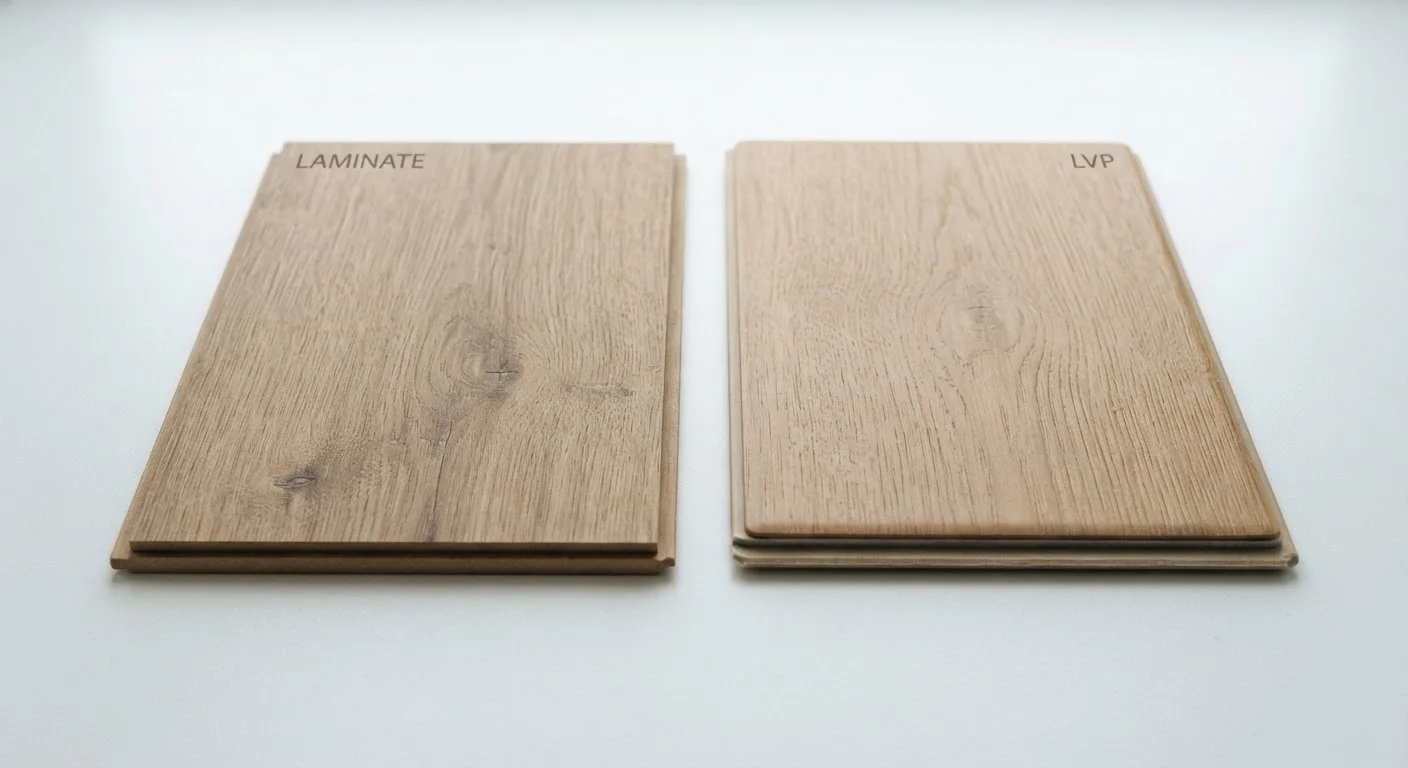
Photo: clearvisionmethod.net editorial
—— In This Article
Key Takeaways
- Laminate has a wood-fiber core that swells when wet; LVP has a plastic core that does not.
- Both floors use a click-lock floating installation, but LVP tolerates subfloor imperfections slightly better.
- LVP generally costs more per square foot than entry-level laminate but less than mid-grade laminate.
- Laminate is typically harder underfoot and resists surface scratches better than softer vinyl planks.
- Neither floor should be installed over a subfloor with active moisture problems; fix leaks first.
How each floor is built
The appearance of laminate and LVP can be nearly identical from across a room. Both use a photographic image layer printed to mimic wood grain, and both click together without glue or nails. The difference lives in the core.
Laminate is built around a high-density fiberboard (HDF) core, which is compressed wood fiber bonded with resin. That core is rigid and dimensionally stable in dry conditions, but wood fiber absorbs water. Even a small amount of moisture seeping through a seam or sitting at the edge of a plank can cause the core to swell, creating permanent ridge lines or bubbling at the surface.
LVP is built around a plastic composite core, usually rigid PVC or a stone-plastic composite (SPC). Neither material absorbs water. The planks can be submerged briefly without permanent damage, and they do not swell or buckle when humidity rises in a bathroom or basement.
Both floors sit on top of the subfloor as a floating installation, meaning they are not fastened to the subfloor itself. That makes either option manageable as a DIY project for a homeowner with basic tools.
Subfloor requirements and preparation
| Criterion | Laminate flooring | Luxury vinyl plank (LVP) |
|---|---|---|
| Core material | High-density fiberboard (HDF) | PVC or stone-plastic composite |
| Waterproof | No | Yes |
| Installation method | Floating click-lock | Floating click-lock |
| Subfloor flatness tolerance | 3/16 in. per 10 ft. typical | Slightly more forgiving (SPC) |
| Scratch resistance | Generally higher | Moderate, varies by wear layer |
| Feel underfoot | Firm, rigid | Slightly softer on thin products |
| Suitable rooms | Dry areas only | All rooms including wet areas |
Laminate demands a flat, dry subfloor. Most manufacturers specify no more than 3/16 inch of variation across 10 feet. High spots must be sanded or ground down; low spots must be filled with floor-leveling compound. Any moisture reading above the manufacturer's threshold (typically measured with a moisture meter) means the floor cannot be installed until the source is corrected.
LVP, particularly SPC products, tolerates minor subfloor imperfections slightly better because the rigid plastic core bridges small gaps without flexing. That said, a severely uneven subfloor will still cause LVP to crack at the locking joints over time, so proper prep is not optional for either product.
One subfloor detail that matters for both: always check whether an underlayment is attached to the plank already. Many LVP and some laminate products come with pre-attached foam underlayment. Installing a separate pad underneath a plank that already has one can make the floor feel spongy and may void the warranty.
Cost and feel underfoot
Entry-level laminate typically runs lower per square foot than comparable LVP, though mid-grade and thick laminate products can cost as much as basic LVP. Material prices shift frequently, so get current quotes before budgeting a project. Installation labor costs are similar for both, since the click-lock process is the same.
Laminate feels harder underfoot because the HDF core does not compress. LVP, especially thinner products, can feel slightly softer or hollow-sounding underfoot when no underlayment is present. Thicker LVP (6 mm and above) and SPC products feel closer to laminate in rigidity.
Sound transmission is worth considering if you are installing above a lower level. Both floors can amplify footstep noise without underlayment. A good acoustic pad beneath either product reduces that significantly, and it is one of the more cost-effective upgrades during installation.
A note on warranties and moisture claims
Many laminate manufacturers offer warranties that cover moisture damage only under specific conditions, such as spills wiped up within a defined time window. Read the warranty before assuming coverage. LVP warranties vary too: the waterproof claim covers the core, not the subfloor beneath it. Water that travels under the planks from a wall gap or drain can still cause problems below the floor even if the planks themselves survive intact.
Which rooms suit each floor
Laminate belongs in dry spaces. Bedrooms, living rooms, dining rooms, and hallways are where it performs consistently over a long lifespan. Kitchens are borderline: laminate can work in a kitchen where spills are wiped up promptly, but a slow leak under the dishwasher or a recurring splash zone near the sink puts the floor at real risk.
LVP is the more practical choice for bathrooms, laundry rooms, kitchens, and below-grade spaces like basements. The waterproof core removes the guesswork about moisture exposure in those rooms. If you are flooring an entire home and want one product throughout for a seamless look, LVP gives you that flexibility without creating a moisture-risk zone in wet rooms.
In both cases, the wear layer thickness determines how long the surface holds up to foot traffic. A 12-mil wear layer is adequate for most residential use; 20 mil is worth the extra cost in high-traffic areas or commercial-adjacent spaces.

Home & Garden Editorial Team
Home & Garden Editorial Team is the collective byline for our editorial team and contributor network. Articles published under this byline or an editorial pen name are researched, written, and reviewed according to our editorial standards for clarity, consistency, and independence before publication.
View author profile